
Understanding Binary Tree Maximum Height
Explore how to determine the maximum height of a binary tree 🌳 in computer science. Learn methods, challenges, and real-world uses with clear examples 📊.
Edited By
Mia Bennett
Binary trees are fundamental structures in computer science, widely used in data organisation, search algorithms, and decision-making processes. Understanding the depth of a binary tree is key to analysing its efficiency and behaviour.
Depth, sometimes called height, refers to the longest path from the root node down to the furthest leaf node. This measure helps gauge the balance and performance of operations like insertion, deletion, and traversal. For example, a balanced binary tree typically has a depth proportional to log₂ of the number of nodes, meaning operations can run in logarithmic time. But if the tree becomes skewed, the depth can grow closer to the number of nodes, leading to slower, linear-time access.
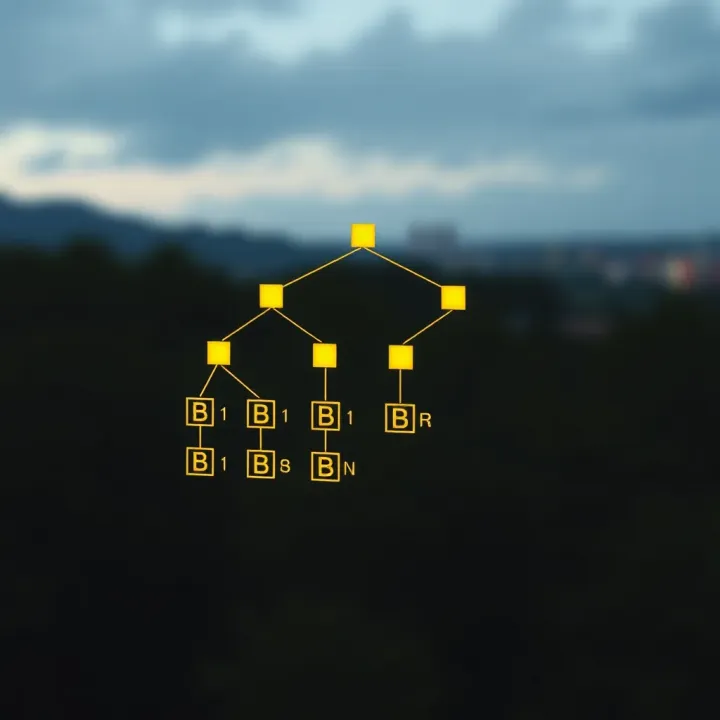
Depth impacts the efficiency of many algorithms that use binary trees, making its calculation and understanding crucial for practical applications.
To determine the depth, one must consider all paths from root to leaves and pick the maximum length. This can be done using recursive methods or iterative techniques like breadth-first search (BFS). For instance, a recursive approach checks the depth of left and right subtrees and returns the greater of the two, plus one for the current node.
Database indexing: B-Trees and binary search trees rely on balanced depth for fast data retrieval
Memory management: Efficient storage depends on balanced tree structures
Network routing and parsing: Decision trees often use depth to determine complexity and processing time
To avoid pitfalls, such as unbalanced trees increasing depth unnecessarily, several optimisations are used. Self-balancing trees like AVL and Red-Black trees automatically maintain low depth, preserving search efficiency.
In summary, grasping binary tree depth helps traders or analysts who implement algorithmic models to efficiently process large datasets, improving decision-making speed and resource use. Understanding its calculation and effects enables better algorithm design and application performance.
Binary tree depth is a key concept in computer science, particularly when working with data structures and algorithms. It refers to the longest path from the root node down to the farthest leaf node in a binary tree. Understanding this depth helps explain the structure and performance characteristics of trees, which are fundamental to organizing data efficiently.
A binary tree is a hierarchical data structure where each node has at most two child nodes — often called the left and right child. This structure enables efficient searching, insertion, and deletion operations, common in databases, parsers, and network routing. For instance, a binary search tree (BST) helps quickly locate elements by dividing the search space at each node.
Depth measures how 'deep' a tree extends from its starting point. More precisely, depth is the length of the longest route from the root to any leaf. This differs from related terms like height and levels: height generally refers to the number of edges on the longest path from a given node to a leaf, often used interchangeably with depth in some texts. Levels count layers from the root, starting at zero or one. Knowing these distinctions clarifies how tree structures behave in practice, affecting the efficiency of traversal and data retrieval.
Depth directly influences how traversal algorithms perform. Consider in-order, pre-order, or post-order traversals; the time taken depends on tree depth since deeper trees involve more recursive or iterative calls. For example, a skewed binary tree (like a linked list) has a depth equal to the number of nodes, causing traversal to slow down considerably compared to a balanced tree.
On top of traversal, depth affects memory use and processing time. Deeper trees generally require more stack space in recursion and more steps in iterative traversals. In resource-constrained environments like embedded systems or low-memory servers, managing tree depth can prevent stack overflow errors and reduce processing delays. Hence, keeping track of depth is vital for optimising tree operations and maintaining system stability.
Understanding binary tree depth is not just academic — it has real consequences on how efficiently your programs run and how much memory they consume.

In summary, comprehending binary tree depth helps developers select the right tree structures and algorithms for tasks ranging from financial data analysis to stock market prediction models. With this foundation, you can better appreciate advanced topics like depth calculation methods and optimisation strategies discussed next.
Calculating the depth of a binary tree helps understand its structure and efficiency. Depth informs us about the longest path from the root node to a leaf, which ties directly to how costly certain operations like search or insertion might be. Knowing methods to measure depth allows programmers and analysts to optimise algorithms and maintain performance, especially in complex or large-scale trees.
The recursive method for finding binary tree depth is straightforward and widely used. It measures depth by exploring both left and right subtrees, then picking the larger among the two depths at each node, adding one for the current node's level. This technique fits naturally with the tree's hierarchical nature, making the code concise and easy to follow.
At its core, recursive depth calculation involves breaking the problem into smaller sub-problems until it hits the tree's leaves. Practically, this mimics how you would manually trace through a tree on paper and is useful in scenarios where the tree's shape isn't known beforehand.
Handling base cases correctly is vital in recursion. The base case typically occurs when the function encounters a null or empty node, marking the end of a branch. Returning zero here prevents further unnecessary calls and acts as the foundation to build up the total depth. Without a clear base case, recursion can lead to infinite loops or stack overflow errors.
This base case also ensures that the recursion terminates safely, providing a precise depth count. It helps in cases with unbalanced trees where branches may vary widely in length.
The iterative method uses level order traversal (also known as breadth-first search) to calculate depth. It visits nodes level by level, counting how many levels exist until it exhausts all nodes. This works well for trees stored in memory where accessing nodes sequentially is efficient.
In practice, level order traversal maintains a queue to hold nodes of each level. By processing all nodes of one level before moving to the next, it naturally counts the depth through the number of cycles. This approach is effective for cases where recursion could lead to stack overflow, such as very deep or unbalanced trees.
Using queues in iterative depth measurement simplifies managing the nodes yet to be processed. The queue holds all nodes at the current level; once these nodes are handled, the queue updates with their children for the next level. This repetitive process continues until the queue empties, ensuring a complete traversal.
This structure also supports visualising the tree level-wise, which can be handy in debugging or when representing tree data in UI layers or reports.
Time complexity for both recursive and iterative methods generally remains O(n), where n is the number of nodes, since each node is visited once. However, space complexity differs; recursion depends on call stack depth, risking stack overflow with very deep trees, while iteration uses queues that may temporarily hold nodes from entire levels.
In typical balanced trees, recursion remains neat and efficient. But with large unbalanced trees or limited stack size environments, iteration is safer. That said, iteration might use more memory at peaks when a level contains many nodes concurrently.
You should choose the recursive approach for simplicity and when dealing with moderately sized trees. Pick the iterative method when handling very deep or unbalanced trees, or when aiming for greater control over memory consumption.
Both methods have their place—understanding your tree's size and structure guides you to the best choice for calculating binary tree depth effectively.
Examining real-world examples of binary trees helps solidify understanding of how depth influences tree behaviour and performance. Practical applications of these calculations reveal why knowing a tree's depth matters beyond theory—it impacts memory usage, traversal speed, and algorithmic efficiency. Through examples, readers see the direct link between abstract concepts and their implications in programming and data processing.
Working through illustrative examples: Starting with small, concrete trees makes grasping depth concepts easier. For instance, take a binary tree with only a root and two children. Calculating depth here shows a depth of 2, meaning the longest path from the root to a leaf covers two nodes. By incrementally adding layers, you can see how the depth increases and how it affects traversal steps. Such step-by-step examples demonstrate how recursive or iterative methods apply in practice.
Interpreting results: Recognising what depth values signify helps in evaluating tree structure quality or efficiency. For example, a depth of 10 in a binary search tree (BST) might indicate unbalanced growth, leading to slower searches. Conversely, a smaller depth with the same number of nodes usually means better balance, translating to faster lookups. Interpreting depth results thus supports optimising data structures, especially when speed and memory constraints matter.
Relation to search trees like BST and AVL: Depth directly influences the balance and performance of search trees. A binary search tree can degrade to a linked list if unbalanced, increasing depth unnecessarily. On the other hand, AVL trees enforce stricter balancing rules to maintain minimum depth, improving search and update times. Understanding depth helps programmers decide on tree types best suited for their use case based on the trade-off between balancing overhead and performance gains.
Influence on algorithm efficiency: Depth often correlates with complexity of tree operations. Traversals like inorder, preorder, or postorder depend on the depth for their recursion or iteration count. In algorithms involving pathfinding or hierarchical computations, deeper trees may require more processing time and memory. By calculating and managing tree depth, developers can optimise algorithms for quicker execution and lower resource use, which is critical in performance-sensitive applications like databases or large-scale data analytics.
Knowing how to calculate and interpret binary tree depth enables informed decisions in designing efficient data structures that scale well in real scenarios, making it indispensable knowledge for traders, analysts, and students dealing with complex datasets.
Calculating the depth of a binary tree seems straightforward at first, but real-world data and complex structures often bring in challenges that can affect accuracy and efficiency. Understanding these challenges, especially with large or unbalanced trees, is key to writing robust algorithms. Optimising depth calculations not only helps prevent runtime errors but also enhances performance, which is critical when handling real-time data or large datasets in trading algorithms or financial simulations.
Risks of stack overflow in recursion: Recursive methods are common for calculating binary tree depth because they mimic the natural tree structure. However, when a tree is very large or heavily skewed to one side, recursion can lead to deep call stacks. This happens because each recursive call adds a new layer to the call stack, and if the tree depth becomes too large, the system might run out of stack memory and crash with a stack overflow error. For example, trying to find the depth of a binary search tree with one side always having nodes (like a linked list) can cause this issue.
Memory considerations: Large trees not only challenge recursion but also consume more memory when handled in iterative approaches, especially if queues or stacks store many nodes simultaneously. For depth-first strategies, the maximum memory can equal the height of the tree, while breadth-first strategies can require memory proportional to the widest level of the tree. In an unbalanced tree where some levels contain a large number of nodes, these structures may grow big and strain limited memory resources. This is particularly relevant in resource-constrained environments or when processing data on edge devices.
Tail recursion and iterative improvements: Tail recursion can help reduce the risk of stack overflow because some programming languages optimise tail calls to reuse stack frames. However, many languages, including those commonly used in India like Java or Python, don't always optimise tail recursion effectively. Therefore, converting recursive depth calculations into iterative ones using explicit stacks or queues remains practical. Iterative methods control memory usage better and avoid deep call stacks entirely.
Caching intermediate results: Memoisation or caching can save intermediate depth calculations for subtrees, avoiding redundant work when the same subtree is visited multiple times, especially in trees with shared structures or repeated patterns. For instance, dynamic programming techniques store depth values of previously computed nodes, significantly speeding up the computation. This approach benefits large or complex trees by reducing repeated calculations and preventing exponential time complexity in worst cases.
Optimising binary tree depth calculations is not just an academic exercise. It directly impacts how efficiently applications—from search algorithms to financial data processing—perform on real data, especially when dealing with vast or irregularly structured datasets.
Overall, balancing between recursive clarity and iterative stability, combined with sensible caching where applicable, ensures depth calculations remain reliable and fast, even for challenging tree structures.
Explore how to determine the maximum height of a binary tree 🌳 in computer science. Learn methods, challenges, and real-world uses with clear examples 📊.
Explore how to find the maximum height of a binary tree 🌳. Learn recursive & iterative methods, understand time & space complexity, and real-world uses.

Explore the Optimal Binary Search Tree algorithm in DAA 📚 Learn its dynamic programming steps, practical uses, time complexity & implementation challenges.

Explore how binary search trees work: insertion, searching, deletion, traversal explained with practical examples 🌳🔍 Enhance your data structures skills today!
Based on 5 reviews