

Optimal Binary Search Tree Algorithm Explained
Explore the Optimal Binary Search Tree algorithm in DAA 📚 Learn its dynamic programming steps, practical uses, time complexity & implementation challenges.
Edited By
Emily Thompson
Binary Search Trees (BSTs) might not be the hottest topic on the trading floor, but they're a quiet powerhouse behind many quick searches and efficient data storage techniques. For traders, investors, and financial analysts alike, understanding BSTs can give you a leg up when dealing with algorithmic trading systems or financial software that relies heavily on data structures for speed and accuracy.
A BST is a type of data structure that keeps data sorted in a way that allows for fast insertion, searching, and deletion. Imagine it as a well-organized filing cabinet where every file has its perfect spot – this order helps you find what you’re looking for without having to open every drawer.

In this article, we’ll cover the nuts and bolts of how BSTs work, focusing on the key operations you'll encounter:
Insertion: How new data makes its way into the tree without disrupting the order.
Searching: Quickly locating a specific value among possibly thousands.
Deletion: Removing data while maintaining the BST structure.
Traversal: Different ways to walk through the tree for various purposes.
By walking through realistic examples and shedding light on how these operations function, this guide will help you grasp the practical side of BSTs, making it easier to incorporate their logic into your financial models or software projects.
Knowing how BSTs operate isn’t just for computer scientists; it’s a handy skill in the world of finance too, where speed and accuracy can make or break a deal.
Stay with me as we break down these operations step by step, clearing up any confusion and helping you to see the bigger picture behind this classic data structure.
Binary Search Trees (BSTs) form a backbone of many algorithms and data structures in computer science, especially when fast retrieval, insertion, or deletion of data is required. Their structure allows for organized storage of sorted data, making searches more efficient compared to simple lists or arrays. For traders or financial analysts working with continuously updated data sets, understanding BSTs can be a game-changer for optimizing search and update operations.
In this section, we'll unpack what makes a BST unique and useful. The grasp on BSTs is essential because they balance the need for quick access with dynamic data management, unlike static sorted arrays which can be slow to update. Whether you're building a portfolio management tool or analyzing market trends, knowing BST fundamentals helps you design systems that handle large volumes of data smoothly.
A BST is defined by a simple but critical property: every node has at most two children, and nodes are arranged so that the left subtree contains only values less than the node's value, while the right subtree contains only values greater than it. This order guarantees that an in-order traversal visits the nodes in ascending order.
Think of a BST node like a checkpoint in a marathon that streams runners either left or right based on their timing. This property allows for efficient lookup, insertion, and deletion because it reduces the search space roughly in half at each step.
While all BSTs are binary trees, not all binary trees are BSTs. The main difference lies in the ordering rule. A binary tree can be any tree with nodes having up to two children, but the values have no specified ordering. Because of this, searching in a plain binary tree can be much slower - often requiring a full traversal.
Imagine a binary tree as a messy folder system where documents are scattered without order, while a BST is a neatly sorted filing cabinet. The order in BSTs allows for predictable, faster operations.
BSTs pop up everywhere you'll need quick, dynamic data access. In financial applications, for example, BSTs can help manage stock price data that keeps changing, allowing quick updates while maintaining sorted order for queries like "find all stocks priced below a certain value."
Beyond finance, BSTs are fundamental in implementing dynamic sets and maps, like indexing in databases, priority queues, and in many search algorithms. Their versatility across domains makes them a solid foundational tool.
Compared to arrays or linked lists, BSTs offer logarithmic time complexity (O(log n)) for insertion, deletion, and search in average cases. This beats linear time of unsorted lists and matches sorted arrays but with much faster update capabilities.
While hash tables offer constant time lookups, they don't maintain order, which is critical for range queries or rank-based retrievals common in investment analysis or real-time monitoring.
In short, BSTs strike a balance: they maintain sorted data efficiently while supporting quick insertions and deletions, making them indispensable in scenarios demanding ordered and dynamic data management.
Inserting elements into a Binary Search Tree (BST) is fundamental to maintaining its structure and usefulness. This process isn't just about throwing data in; it's about placing each value carefully so that the BST properties hold firm. These properties ensure quick data lookup, sorted order traversal, and efficient updates—key factors for users like financial analysts or students dealing with large data sets.
Consider a trader who keeps a record of stock prices. Inserting these prices correctly in a BST allows quick searching later—for example, to find the closest price above or below a target. Hence, understanding insertion isn’t just academic; it directly impacts performance and reliability in real-world tasks.
Before adding a new node, you must first find the right spot in the tree. This involves starting at the root and moving down, comparing the value to be inserted with the current node's value. If it’s smaller, move left; if bigger, move right.
This step is crucial because it maintains the BST property where left children are smaller and right children are larger than their parent nodes. If you didn’t follow this pattern, the tree wouldn’t stay sorted, and searching would become slower—almost like looking for a needle in a haystack.
For example, if you want to insert the value 25 into a BST where the root is 30, you'd go left since 25 is less than 30. Then, suppose you encounter a node with the value 20; since 25 is greater, you'd move right. Repeat this until you find an empty spot to place the value.
Once you locate the proper spot, insert the new node there directly as a leaf node. This keeps the BST balanced in terms of where values fall—though not necessarily perfectly balanced overall. By always adding new values at the end of the traversal path, you avoid breaking the BST's sorting rules.
For instance, if you insert the number 40 into the tree with a root at 30, you traverse right because 40 is larger. If the right child is empty, the new node becomes its right child. This simple step enforces the BST order.
Remember, misplacing a node can cause headaches down the line, slowing down searches and complicating deletions.
BSTs usually expect unique values, but in real-life datasets, duplicates happen. There are a few ways to deal with them:
Reject duplicates outright: Ignore insertion if the value is already present. This keeps the tree clean but might not fit all use cases.
Allow duplicates on one side: Typically, duplicates go either left or right consistently. For example, all duplicates might be inserted to the right.
Store a count or list: Instead of multiple nodes with the same value, keep a count or a list at the node representing how many times that value appears.
Using the count method can be especially handy for financial data where multiple trades at the same price occur; you'd keep a tally instead of cluttering the tree with identical nodes.
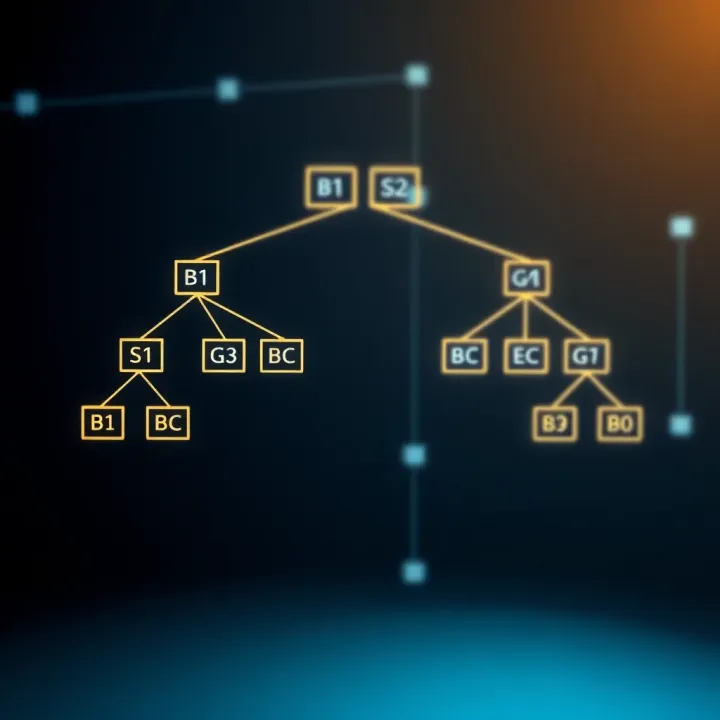
Allowing duplicates changes how the tree grows. For example, putting all duplicates on one side can skew the tree, potentially making it unbalanced and slowing down operations.
Imagine a BST where many identical prices keep getting inserted and all go to the right child. This could form a long line of nodes rather than a balanced tree, which means operations like search may degrade from O(log n) to O(n) time.
Maintaining balance and performance might require additional techniques, like tree rotations or switching to self-balancing BSTs such as AVL trees or Red-Black trees.
Handling duplicates thoughtfully ensures your BST stays efficient and practical for applications like managing trading records or analyzing market trends.
Searching is one of the fundamental operations that highlight why binary search trees (BSTs) are so useful, especially in scenarios where quick lookup of data is necessary. Whether you’re working on trading platforms where quick access to stock data is essential or managing large datasets of financial records, understanding how to efficiently search in a BST can save you a lot of time. This section breaks down how search works in BSTs and why it’s an important part of working with this data structure.
Every search in a binary search tree kicks off at the root node—the topmost node of the tree. This makes sense when you think about a BST like it’s a filing cabinet organized alphabetically or numerically: you have to open the first drawer (the root) before moving deeper. Starting from the root is practical because it sets the context for comparisons and guides the direction of the search. For example, if you’re trying to find a stock symbol like "INFY" in a BST holding ticker symbols, you begin at the root and decide whether to go left or right based on alphabetical comparison.
The magic of BST searching happens when you compare the value you’re searching for against the current node’s value. If it’s smaller, you go left; if it’s greater, you go right. This comparison continues recursively or iteratively until you either find the value or reach a dead end (a null reference). This left-or-right traversal significantly reduces the search space at every step, which is much faster than scanning every node in a list. As an example, imagine looking for the value 45 in a BST; if the root is 50, since 45 50, you move left, skipping all nodes with values greater than 50.
The speed of searching in a BST depends heavily on the tree's shape. In the best case—think of a perfectly balanced BST—search time is about ( O(\log n) ), meaning every step cuts the search space roughly in half. For example, in a balanced BST with 1024 nodes, finding a value typically requires around 10 comparisons.
On the flip side, the worst case happens when the BST resembles a linked list (all nodes have only one child). This can happen when inserting already sorted data without balancing. In such cases, search takes ( O(n) )—checking each node one by one. This is no better than a simple list scan and negates the main benefit of BSTs.
How well the BST stays balanced directly impacts search speed. Balanced BSTs like AVL trees or Red-Black trees automatically ensure the tree doesn’t get lopsided, maintaining efficient search times. When the tree is unbalanced, it drags performance down. For instance, if an investor’s transaction timestamps are stored in an unbalanced tree, finding a specific timestamp might take much longer than expected. Keeping the tree balanced can be a game changer for real-time querying and quick data lookups.
Remember, keeping your BST balanced isn't just academic; it’s what keeps search times snappy, especially when you're juggling heaps of data, like millions of stock transactions or market feeds.
In summary, searching in BSTs is quick and efficient when the tree is well balanced and the search starts at the root, guided by left-or-right comparisons. This method is particularly relevant for traders or analysts who need to retrieve data fast without scanning entire datasets.
Removing elements from a Binary Search Tree (BST) is just as important as inserting and searching. It keeps the tree dynamic and accurate for operations like data lookups, and also prevents the tree from getting overloaded with obsolete or unnecessary values. For traders or financial analysts, imagine a BST storing stock prices updated in real-time; removing outdated entries quickly is essential to maintain the integrity of the data.
The challenge, however, lies in preserving the BST properties when nodes are deleted. If not done correctly, the tree can lose its order, making future searches inefficient or even incorrect. This section digs into the practical methods of removing nodes while keeping the tree structured and balanced.
When it comes to deletion, we deal with three straightforward cases, each with its own approach and considerations.
Deleting leaf nodes: These are the simplest to remove. Since leaf nodes have no children, you can just cut them off without worrying about rearranging the tree. For example, if a broker's database has a BST of client IDs and one client closes their account (represented by a leaf node), the node can be directly removed to reflect the change.
Deleting nodes with one child: This situation needs a bit more care. When the node to be deleted has one child, the idea is to bypass the node and link its parent directly to the child. This keeps the BST structure intact. Think of this like removing a middleman but keeping the connection between two key players.
Deleting nodes with two children: This is the trickiest case. You can't simply remove the node or it’ll break the BST property. Instead, you replace the deleted node’s value with either its in-order successor or predecessor (more on that ahead), then delete that successor/predecessor node which will now have at most one child. For financial systems tracking transaction histories or prices, handling this case properly ensures the data stays searchable and organized.
To delete a node with two children, BST deletion strategies typically involve substitution to maintain order.
Replacing with in-order successor: The in-order successor is the next higher value node in the BST, usually found as the smallest node in the right subtree. Replacing the node to delete with its successor keeps the BST's sorted order intact. For illustration, picture removing a stock ticker symbol from a sorted list and replacing it with the next symbol above it alphabetically. This strategy is often preferred because the in-order successor’s position simplifies removal afterward.
Replacing with in-order predecessor: Conversely, this uses the largest node in the left subtree (the immediate smaller value) to replace the deleted node. Think of it like swapping a financial record with the closest lower-value record. This can be more suitable in some data distributions or implementations. Both approaches balance the tree by keeping elements sorted, but the choice depends on specific application needs or developer preference.
Key point: The choice between successor and predecessor is a design decision, but both methods ensure the binary search property stays intact after deletion.
Having a clear grasp of these deletion scenarios and strategies is crucial for anyone working with BSTs, particularly where data lives and updates dynamically—just like fast-moving markets or evolving financial portfolios. Proper delete operations maintain the tree's integrity, speed up searches, and keep memory usage under control.
Traversal refers to the way you visit every node in a binary search tree (BST), and it plays a big role in how you use BSTs effectively. Whether you need to search for sorted data, print nodes in a particular order, or prepare the tree for certain operations, traversal methods provide the roadmap. In simple terms, traversal helps you access all elements without missing any, respecting the binary search tree properties.
When working with a BST, it's not just about having the data stored; how you walk through this data matters a lot. Traversing can reveal the tree’s structure, help in debugging, or support other operations like deleting or balancing the tree. For example, if you're managing a stock portfolio with a BST that indexes stocks by their ticker symbols, traversal allows you to list all stocks alphabetically or in the exact order they were added.
In-order traversal is pretty straightforward and is the go-to approach when you want to access BST elements in sorted order. It follows this simple rule: visit the left subtree, then the current node, and finally the right subtree. Because BST nodes are arranged so that left children are smaller and right children are larger, this method results in nodes being visited from smallest to largest.
To put it in context, think of a BST holding share prices. Using in-order traversal, you can quickly pull a list of all prices sorted from low to high, making analysis or reporting more intuitive.
The sorted output from in-order traversal finds use in lots of practical cases:
Reporting sorted data: For investors, it’s useful when you need a sorted list of assets or transactions.
Checking BST correctness: Developers use it as a simple test to ensure the BST is structured properly—if the output isn’t sorted, something’s off.
Data transformation: When you need to convert the BST into an array or list for further processing.
In-order traversal is the bread and butter for any operation that requires sorted data from a BST. It’s like reading a book from start to finish—nothing’s skipped or out of place.
Pre-order and post-order traversal differ from in-order mainly in the sequence nodes are visited:
Pre-Order: Visit the current node first, then the left subtree, followed by the right subtree.
Post-Order: Visit the left subtree, then the right subtree, and finally the current node.
Think of pre-order as checking your to-do list first before diving into the details, while post-order is like wrapping things up after handling all subtasks.
Pre-Order Traversal: Useful when you want to create a copy of the tree or serialize the tree structure (e.g., saving the layout of a decision tree). Pre-order offers a way to capture the root before its branches.
Post-Order Traversal: Great for deletion operations where you want to delete child nodes before the parent, such as cleaning up resources or dismantling structures. This way, you avoid losing references when parents are removed first.
To provide a concrete example, a stock market algorithm might use pre-order traversal to replicate a watchlist across different platforms efficiently. Alternatively, when clearing or rebalancing data, post-order ensures you handle dependencies neatly before uprooting the main node.
By understanding which traversal suits your needs, you ensure smoother operation whether it’s for data extraction, tree manipulation, or efficient data presentation.
Binary Search Trees (BSTs) shine when they're well balanced, keeping operations like search, insertion, and deletion snappy. But when these trees tilt too far one way, their performance can nosedive. This section sheds light on why keeping BSTs balanced is more than just a neat trick and dives into the methods used to maintain that balance. For anyone relying on BSTs to manage data efficiently—be it trading algorithms or financial models—the importance of balance can't be overstated.
When a BST becomes unbalanced, it starts behaving more like a linked list, flattening out and losing its efficiency. Imagine a trader's database where new stock prices keep getting added in increasing order—without balance, the tree stretches out, making searches, say for a specific price point, far slower than they should be. The impact? Operations that ideally take logarithmic time (O(log n)) degrade to linear time (O(n)), dragging down overall system responsiveness.
An unbalanced BST can slow down critical operations, leading to delays that aren't acceptable in fast-paced environments like financial trading.
Maintaining balance preserves the tree’s height, ensuring that tools depending on quick lookup and update operations don't get bogged down. In short, balance keeps the BST nimble, helping traders and analysts get the results they need swiftly.
Instead of manually fixing trees, certain BST variants auto-adjust themselves during insertions and deletions to stay balanced. Popular types include AVL trees and Red-Black trees. AVL trees maintain stricter balance but might require more rotations, while Red-Black trees are a bit looser but generally faster for insertions and deletions.
For example, a financial system tracking market orders might use a Red-Black tree to keep data sorted without frequent costly restructures, striking a balance between speed and structural integrity.
Rotations are the backbone of self-balancing BSTs. These are small, localized operations that reshape the tree, improving balance without disturbing the overall order of elements. There are two main types:
Left Rotation: Shifts nodes to the left to fix right-heavy trees.
Right Rotation: Shifts nodes to the right to correct left-heavy ones.
Think of rotations like adjusting a set of dominoes so they stand evenly without toppling. For instance, if a heavy branch weights the tree's right side, a left rotation lifts it back to neutral, quickening search times.
Understanding when and how to apply rotations is key for anyone implementing or working with self-balancing trees in demanding domains, ensuring operations remain efficient even as datasets grow large or change frequently.
When working with binary search trees (BSTs), it's not just about knowing the theory but understanding where they actually shine in real-world scenarios. In practical applications, BSTs provide a great way to manage data that requires frequent searching, insertion, or deletion while maintaining some order. However, knowing when and where to apply BSTs makes a huge difference in performance and efficiency.
Consider an online stock trading platform. Orders and trades come in fast and need quick lookups. A BST helps organize this financial data for efficient retrieval, especially when sorted data access is critical. However, the choice of using BST shouldn’t be blind; it’s important to recognize the conditions under which BSTs offer value.
BSTs excel when you want to keep your dataset sorted without much overhead. They allow quick access to the lowest or highest values, which is handy in financial contexts, like finding the cheapest or most expensive stock in a real-time list. The sorted structure is maintained automatically, unlike arrays that need sorting after every insertion.
What makes BSTs stand out here is how they support range queries efficiently. For example, if you're an analyst needing to find all stocks within a certain price range, an in-order traversal of the BST can retrieve this list quickly without scanning the entire dataset.
Datasets in trading aren’t static—they grow, shrink, and change unpredictably. BSTs handle these dynamic datasets well when the tree is balanced. Operations like inserting new trades or deleting canceled orders take logarithmic time on average, which keeps the system responsive.
Still, a note of caution: if the BST isn’t balanced, performance degrades dramatically, approaching linear time. In practice, self-balancing trees like AVL or Red-Black trees are used to maintain consistent performance, ensuring quick data updates even as the dataset size fluctuates.
BSTs aren't a one-size-fits-all solution. They can be inefficient when data insertions occur in a sorted manner—imagine inputting trades in ascending order of price. Without balancing, the BST can become skewed, resembling a linked list and slowing down operations.
Also, for tiny datasets or applications where only straightforward lookups are needed, the overhead of maintaining a BST might be unjustified compared to simpler data structures like arrays. Complex balancing algorithms add code complexity and can be overkill if update frequency is low.
The traditional rival of BSTs in data management is the hash table. Hash tables offer constant-time average lookup, which often seems better at face value. But, unlike BSTs, hash tables do not maintain any order. If you need sorted data or range queries, hash tables won't cut it.
Moreover, hash tables can suffer from high memory usage and performance hits during collisions or resizing. BSTs, particularly balanced variants, provide a more predictable performance profile and better memory efficiency when ordered data retrieval is essential.
When choosing between BSTs and alternatives like hash tables, always weigh the need for ordered operations against raw lookup speed and complexity of implementation.
Ultimately, the decision boils down to the specific demands of the application and the nature of data you handle.
Explore the Optimal Binary Search Tree algorithm in DAA 📚 Learn its dynamic programming steps, practical uses, time complexity & implementation challenges.

🔍 Explore the optimal binary search technique for faster, efficient data retrieval in sorted arrays. Learn key principles, advantages, and real-world use cases.

🔍 Explore how linear and binary search algorithms work, their pros and cons, and when to use each for efficient data searching in tech applications.
Explore how to determine the maximum height of a binary tree 🌳 in computer science. Learn methods, challenges, and real-world uses with clear examples 📊.
Based on 15 reviews