

Understanding Binary Numbers and Their Uses
Explore how binary numbers work in computing 🖥️. Learn binary basics, decimal conversion, arithmetic, and their role in digital tech 🔢⚙️.
Edited By
Oliver Bennett
Binary trees are one of the most commonly used data structures in computer science. They organise data hierarchically, where each node has at most two children – typically called the left and right child. This simple structure allows for efficient searching, sorting, and traversal, which is why binary trees form the backbone of many algorithms used in programming.
In practice, binary trees help manage data in various applications. For instance, decision trees used in financial analysis rely on binary tree structures to evaluate different scenarios. Similarly, trading algorithms often employ binary search trees to quickly locate price points or orders.
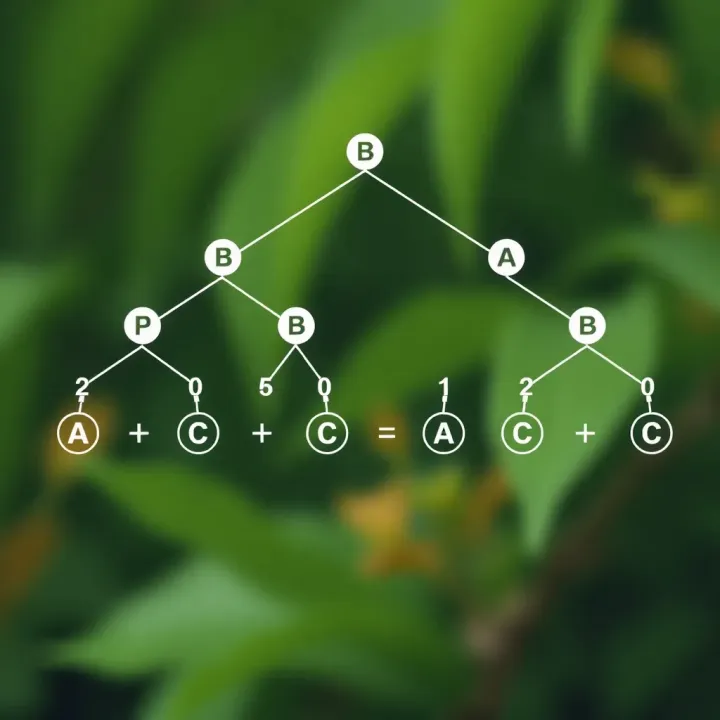
At its core, a binary tree starts with a root node. Each node then branches out to its children nodes, or ends at a leaf node without any children. This hierarchical pattern makes operations like insertion, deletion, or lookup straightforward and time-efficient compared to linear data structures.
Understanding how binary trees organise and manage data gives you the edge to optimise algorithms crucial in trading platforms, stock analysis tools, and real-time decision-making systems.
You'll find binary trees not only in code but hidden inside everyday tools and platforms you use. For example, ranking stocks by performance or sorting investment portfolios can involve binary tree algorithms to speed up computation.
In this article, we'll explore different types of binary trees – from basic binary search trees (BSTs) to balanced variants like AVL and Red-Black trees. We'll also cover traversal methods such as inorder, preorder, and postorder, illustrating how they work. Lastly, practical considerations like memory usage and application contexts will be explained to help you grasp where and why to use binary trees in real-life programming challenges.
Whether you are a student preparing for competitive programming or a financial analyst aiming to understand data structures behind your tools, this guide will strengthen your foundational knowledge about binary trees.
Binary trees form an essential part of data structures in computer science, especially useful for organising and managing data efficiently. Their hierarchical structure simplifies complex problems such as sorting, searching, and representing relationships. For traders and financial analysts, understanding binary trees can help grasp concepts like decision trees in algorithmic trading or hierarchical data storage.
At the core, a binary tree is made up of nodes connected by edges. A node holds the data (like a stock price or an event), while edges represent the links between nodes. Practically, these connections define how data flows or relates within the tree. For example, in representing a company’s organisational chart, nodes are employees, and edges indicate direct reporting lines.
The root node is the topmost node in a binary tree — it’s where all operations begin. Each node (except the root) has a single parent node pointing to it, and can have up to two child nodes. This parent-child relationship establishes direction and hierarchy. Consider a loan approval system where the root is the initial application, parent nodes are decision points, and child nodes represent outcomes or next steps.
Leaf nodes are the end points of a binary tree; they have no children. These nodes represent final states or data points. In a stock trading algorithm’s binary decision tree, leaf nodes could signify final buy/sell/hold decisions. Identifying leaf nodes helps in scenarios where terminating conditions or outcomes are necessary.
Binary trees underpin many advanced data structures and algorithms. They help organise data for quick retrieval, which is vital in real-time trading platforms handling massive transactions. Binary trees also assist in parsing expressions, managing hierarchical data like folder structures, and supporting search algorithms such as binary search trees (BST). For financial analysts, BSTs optimise data storage and fast lookup, crucial when analysing large datasets like historical stock prices.
A clear grasp of binary trees enhances understanding of efficient data handling, key to high-performance computing in finance and technology.
In summary, binary trees offer a straightforward model to represent hierarchical data, making operations like search, insert, and delete more systematic and efficient. Their practical relevance is widespread, from handling portfolio data to building recommendation engines on e-commerce platforms like Flipkart or Amazon India.
Binary trees come in several types, each with distinct characteristics that impact their performance and practical use in algorithms and data structure management. Understanding these types helps in selecting the right tree structure for specific needs like faster searching, optimised storage, or balanced operations.

A full binary tree is one where every node has either zero or two children, never just one. This structure is common in expression trees where operators have two operands, such as in arithmetic computations. For instance, in parsing mathematical expressions, full binary trees ensure all internal nodes represent operators with two children, making evaluation straightforward.
A complete binary tree fills all levels fully except possibly the last, which fills from left to right. This makes it highly suitable for implementations like heaps, which underpin priority queues in trading algorithms or task scheduling. Since nodes fill systematically, accessing elements at predictable positions helps in efficient memory storage and retrieval.
In a perfect binary tree, all internal nodes have two children, and all leaf nodes lie at the same depth. Such trees are highly symmetrical and guarantee the minimum height for a given number of nodes. This structure is beneficial when uniform access time is critical, such as in some parallel processing tasks or indexing mechanisms used in databases.
A balanced binary tree maintains its height close to the minimum possible, avoiding highly skewed forms. Examples include AVL and Red-Black trees. Balanced trees offer efficient insertions, deletions, and searches—operations often needed in order-driven trading systems or real-time data feeds. By keeping operations near O(log n), balanced trees prevent slowdowns that skewed trees might cause.
Conversely, a degenerate binary tree resembles a linked list, where each parent node has only one child. Though inefficient for searches, understanding this form is essential as it represents the worst-case for binary tree performance. Recognising when a tree degenerates helps in applying balancing techniques or alternative data structures to maintain efficiency.
Each binary tree type comes with trade-offs in terms of memory, speed, and complexity. Choosing the correct type based on the problem context significantly affects algorithm performance.
In summary, knowing these binary tree types prepares you to choose or design tree structures fitting your practical programming or financial data management needs, balancing memory use and access speed efficiently.
Core operations on binary trees shape how effectively this data structure serves its purpose across algorithms and programming tasks. These operations—insertion, deletion, searching, and traversal—directly impact performance, memory usage, and the application's ability to manage hierarchical data efficiently.
Insertion in binary trees depends on the tree type and the required order. For instance, in a binary search tree (BST), if you want to add a new value like 25, you compare it to existing nodes starting from the root—going left for smaller values and right for larger ones—till you find the right empty spot. This systematic approach helps maintain sorted order, essential for quick searches later.
Deletion is trickier because it must preserve the tree’s structure. Say you want to delete a node with two children; you often replace it with the in-order successor (smallest node in the right subtree) or predecessor (largest node in the left subtree), ensuring the BST properties hold after removal. These careful insertions and deletions keep trees balanced and searches efficient.
Searching a binary tree follows similar logic to insertion, especially in BSTs. This operation checks nodes step-by-step to find the required data. For example, if you search for ₹10,000 in a tree storing transaction amounts, you start at the root and move left or right based on comparisons. This method is faster than scanning the entire data set randomly.
However, in unstructured binary trees, searching may require checking almost every node, which is less efficient. Thus, the organisation of the tree greatly influences search speed.
Traversal methods describe systematic ways to visit every node in the tree. Each traversal serves specific purposes depending on the use case.
Preorder Traversal visits the root node first, then recursively the left subtree followed by the right. You might use this to copy the tree or create prefix expressions in compilers, which start evaluating operations from the first operator and then its operands.
Inorder Traversal processes nodes starting from the left subtree, then the root, and finally the right subtree. This traversal yields sorted order in BSTs, making it essential for web search engines indexing or financial systems listing transactions ascendingly.
Postorder Traversal visits left and right subtrees before the root. It's handy in deleting nodes or evaluating postfix mathematical expressions, where the operation happens after evaluating operands, such as in some calculators or expression solvers.
Level Order Traversal scans nodes breadth-wise, level by level, starting at the root. This technique helps when you want to inspect a binary tree layer-wise. It’s practical in networking to broadcast information or in UI rendering where child elements appear only after their parents.
Understanding these operations thoroughly allows programmers and analysts to pick the right binary tree type and method for the job, ensuring speed, memory efficiency, and proper data handling.
Binary trees have a broad range of applications in programming due to their efficient structure that supports quick data access and manipulation. Understanding where and how they apply helps traders, investors, financial analysts, and students appreciate their real-world value in software systems and algorithms.
Binary trees excel in expression parsing, where they represent arithmetic or logical expressions neatly as a tree structure. Each internal node holds an operator (like +, -, *, /), while the leaf nodes hold operands (numbers or variables). For example, the expression (3 + 5) * (7 - 2) maps onto a binary tree where the root is the multiplication operator, with two child subtrees representing the additions and subtractions respectively. This tree structure allows easy evaluation by traversing the tree and computing the result step-by-step, essential in compilers and calculators.
Binary Search Trees (BSTs) form a critical subset of binary trees, designed to store data in a way that speeds up searching, insertion, and deletion. In a BST, the left child of any node contains values less than the node, while the right child contains greater values. This property makes operations like searching for a specific stock price or client record faster than scanning a list. For instance, if a broker needs to quickly find the latest price in a large dataset, using a BST could reduce the time complexity significantly, compared to linear search. However, BSTs must be balanced to prevent degenerate cases that slow down performance.
Binary trees also model hierarchical data well, like organisational charts, file systems, or decision processes. For example, an investment firm's client management system might represent account types and sub-accounts using a binary tree. Each parent node links to children nodes, showing relationship dependencies clearly. This structure supports efficient querying and navigation of complex hierarchies, which is vital for financial analysts tracking portfolios or brokerage operations managing multiple clients.
Binary trees are foundational in programming, providing clear advantages in organising data, executing calculations, and modelling relationships. Understanding their applications can improve the design of systems critical to finance and investment sectors.
In summary, binary trees power expression evaluation in compilers and calculators, promote fast search and storage in BSTs, and facilitate organising hierarchical data. These uses make them indispensable in programming tasks linked to trading platforms, financial analytics, and data management.
Understanding memory usage and operation speeds in binary trees is key for building efficient software, especially when working with large data sets or time-sensitive applications. Inefficient use of space can lead to unnecessary memory bloat, while slow operations may cause delays in real-time systems. Traders, financial analysts, and developers must grasp these factors to optimise algorithms that handle hierarchical data or quick searches.
Space complexity in binary trees generally depends on the number of nodes stored. Each node holds data plus pointers to its children. For example, a binary tree with 1,000 nodes requires space proportional to these nodes and their pointers. Besides node storage, traversal methods may need extra space. Recursive traversals, such as inorder or postorder, consume stack space proportional to the tree's height. For a balanced tree, this height is about log₂(n), but for unbalanced trees, it can approach n. This difference affects memory significantly, impacting applications on devices with limited memory.
The time taken for insertion, deletion, and searching varies with tree shape. In the worst case, an unbalanced binary tree behaves like a linked list, leading to O(n) time complexity. For balanced trees, operations typically run in O(log n) time, much faster for large data. For instance, searching for a stock symbol in a balanced binary search tree could take just a handful of steps even in a database of millions of entries. This efficiency is vital for financial applications where milliseconds count.
AVL trees maintain strict balance by ensuring the heights of two child subtrees differ by at most one at any node. Upon insertion or deletion, rotations rebalance the tree immediately. This keeps search, insertion, and deletion operations at O(log n) time consistently. Although this balancing incurs extra overhead during modifications, the payoff is faster lookups. In trading algorithms where quick data retrieval is mandatory, AVL trees provide dependable speed.
Red-Black trees offer a more relaxed balancing approach. They allow up to double the height of perfectly balanced trees but guarantee balance by colour-coding nodes and enforcing rules during insertions and deletions. This leads to slightly less frequent rebalancing compared to AVL trees. The result is somewhat faster insertion and deletion but marginally slower search times. Red-Black trees suit systems like databases or operating systems, where many insertions and deletions happen, for example managing order books or transaction logs.
Balancing is the key: Choosing the right balance method depends on your application's read-write patterns and timing requirements. For read-heavy tasks, AVL trees may shine, while Red-Black trees excel in write-heavy environments.
Understanding these memory and performance details enables you to select and implement binary tree structures that fit your specific needs efficiently.
Explore how binary numbers work in computing 🖥️. Learn binary basics, decimal conversion, arithmetic, and their role in digital tech 🔢⚙️.

Explore binary numbers 🔢: their structure, how they differ from decimals, methods of conversion, and key uses in computing and digital electronics 💻⚙️.

Explore how optimal binary search trees ⚙️ boost search efficiency with practical examples, dynamic programming methods, and insights tailored for India 🇮🇳.
Explore how optimal binary search trees ⚙️ reduce search times efficiently. Learn key algorithms, structure, and real-world applications in data handling 📊.
Based on 9 reviews